Reading a Clubroom Noticeboard as a Map of Shared Life
Read a clubroom noticeboard as a map of shared life: spot the activities, relationships and routines that hold a sporting community together.
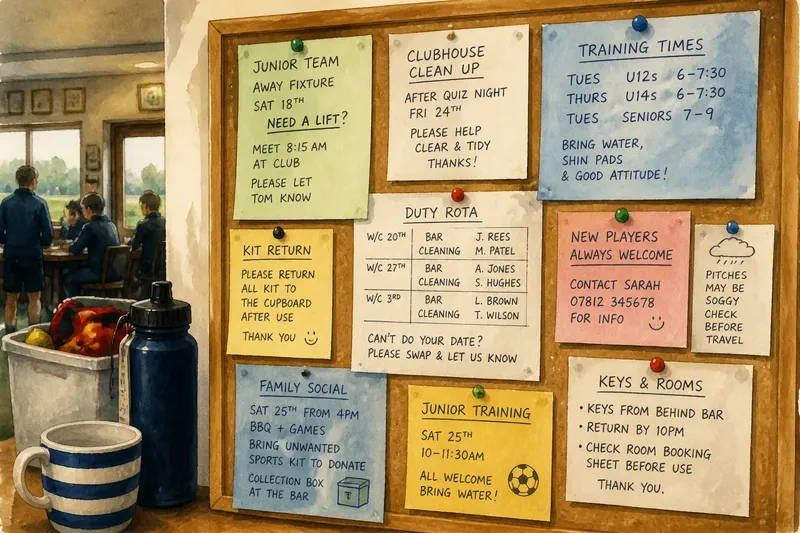
A handwritten note beside the kettle says the junior team needs a lift to an away fixture; below it, a rota asks for help clearing the clubhouse after a quiz. Read a clubroom noticeboard as a map of shared life, and the scraps of paper begin to show how a sporting club works between fixtures. They record not only events, but the people, spaces and small acts of coordination that let those events happen.
The board is not a complete portrait of the club. It is a working surface: some notices are current, others linger, and plenty of activity never reaches the wall at all. Its value lies in what it makes visible. By looking at who is being invited, what is being organised and how messages connect, you can read the club’s everyday life without treating the noticeboard as a formal record.
What does a noticeboard show beyond the fixture list?
A fixture list tells you when a team plays. A clubroom board may also show who gathers there on other evenings, what equipment needs attention and which groups share the same facilities. Training times might sit beside a bowls social, a youth committee meeting or a request for volunteers at a fundraising supper.
Notice the verbs as well as the event names. “Bring”, “collect”, “help”, “return” and “meet” point to actions that make club life possible. A notice asking members to return kit to a particular cupboard, for instance, hints at shared equipment and a practical system for looking after it.
That does not mean every item carries a hidden message. A reminder may simply be a reminder. The useful habit is to treat the board like a kitchen table: the objects on it are ordinary, but their arrangement can show what people are doing together and what needs attention next.
How do dates and repeated notices reveal club routines?
Look for recurring patterns. The same evening may be reserved for youth training, the same corner may advertise a regular social gathering, and a familiar name may appear on several duty rotas. Those repetitions suggest the rhythms that members organise their week around.
Then look for exceptions. A one-off change of venue, an extra practice or a postponed event can reveal how the club responds when its usual arrangements shift. Compare the notice with nearby information rather than assuming a change signals a wider problem: a weather note or a room-booking update may explain it plainly.
Dates also help distinguish an active notice from one that has outlived its purpose. A sheet with no date, contact name or indication of the relevant season is harder to interpret than a current schedule pinned beside it. If you are responsible for the board, remove or mark outdated notices so an old invitation does not compete with a new one.
Who appears in the messages, and who is being invited?
Names can show how work and responsibility are distributed. A contact person on a coaching notice gives a newcomer somewhere to start; a rota with several names suggests that a task is shared. If the same person appears on many unrelated notices, that may point to a useful organiser, but it can also show how much coordination rests on a few familiar members.
Pay attention to the audience each message assumes. “All members welcome” is different from a note addressed only to a particular team. Terms such as “new players”, “parents”, “volunteers” or “clubhouse users” tell you who the writer has in mind, and sometimes who may not yet feel included.
Language can make participation feel straightforward or obscure. A notice that says where to meet, what to bring and whom to contact gives readers a clear way in. A message full of unexplained initials or insider shorthand may make perfect sense to regulars while leaving a newcomer unsure whether the invitation applies to them.
What do notices about rooms and kit tell you?
Club life is tied to practical places: the changing room, storage shed, kitchen, meeting room and playing surface. A note about access to a room, a key collection point or where wet kit should be left shows how people move through shared spaces. These details can reveal which activities happen indoors and how different groups use the same building.
Equipment notices add another layer. A request to label borrowed kit or put training bibs back in a named box shows that the objects are shared and need to be accounted for. A notice about a repair or replacement may indicate that a team depends on equipment maintained by members, rather than on a separate service.
When a message gives instructions about access, equipment or a facility, follow the posted directions and ask the club’s named contact if anything is unclear. Local arrangements and manufacturer guidance can matter, particularly where equipment or restricted areas are involved.
How can small messages connect different parts of the club?
A noticeboard often places groups side by side that meet for different reasons. A junior practice schedule, a senior team’s social invitation and a request for help at a community event may all share the same wall. Their proximity can show that the club is more than one team, while the words on each notice show whether those groups are actually being invited to mix.
Watch for messages that create a bridge. A family event linked to a match, a shared transport request or an invitation to help with a junior session connects people who might otherwise use the club at different times. Such notices make the club’s relationships visible through practical arrangements, not grand statements about togetherness.
Imagine a small club where a note asks members to bring unwanted sports kit to a Saturday social, while a separate sheet lists a junior training session that morning. If the social notice names a contact and says where donations will be collected, it gives families and adult members a clear point of connection. The board does not prove that people will meet, but it shows how the club has made that meeting possible.
What questions help you read a clubroom noticeboard?
How can I tell whether a notice is still current?
Check for a date, season, named contact and any nearby update that changes the arrangement. If the notice is undated and its timing is unclear, ask the relevant organiser rather than relying on it.
What does repeated handwriting or a familiar name mean?
It may show that one person regularly coordinates a task or keeps a group informed. Treat it as a clue about responsibility, not proof that the person controls every decision.
Why are some club notices difficult for newcomers to understand?
Regular members often know the initials, room names and routines without explanation. A short plain-language line giving the full name, location and contact route can make the same message useful to a wider group.
Should I photograph or share a noticeboard message?
Ask before sharing a photograph if it includes personal contact details, children’s names or private information. A public event announcement is different from a duty rota or message intended only for members.
How can a club make its board easier to read?
Arrange notices so readers can find the kind of information they need. Separate schedules from social events and practical requests, and keep a small space for urgent changes. Clear headings help, but the wording beneath them should still say who the message is for and what action is needed.
- Date it: Include the event date or the period a schedule covers.
- Name a contact: Give a suitable route for questions, without exposing personal details unnecessarily.
- Explain local terms: Expand initials or unfamiliar room names for occasional users.
- State the action: Say whether readers should attend, reply, bring something or simply take note.
- Review old sheets: Remove expired notices or mark them clearly as past information.
These choices make the board easier to use, but they also shape what becomes visible as club life. A board filled only with fixtures presents one picture; a board that also records volunteering, social gatherings and shared responsibilities gives a fuller account of how members spend time together.
Next time you pass the board on your way out, look for the message that links one group to another. That small connection may tell you more about the club’s shared life than the largest fixture notice on the wall.